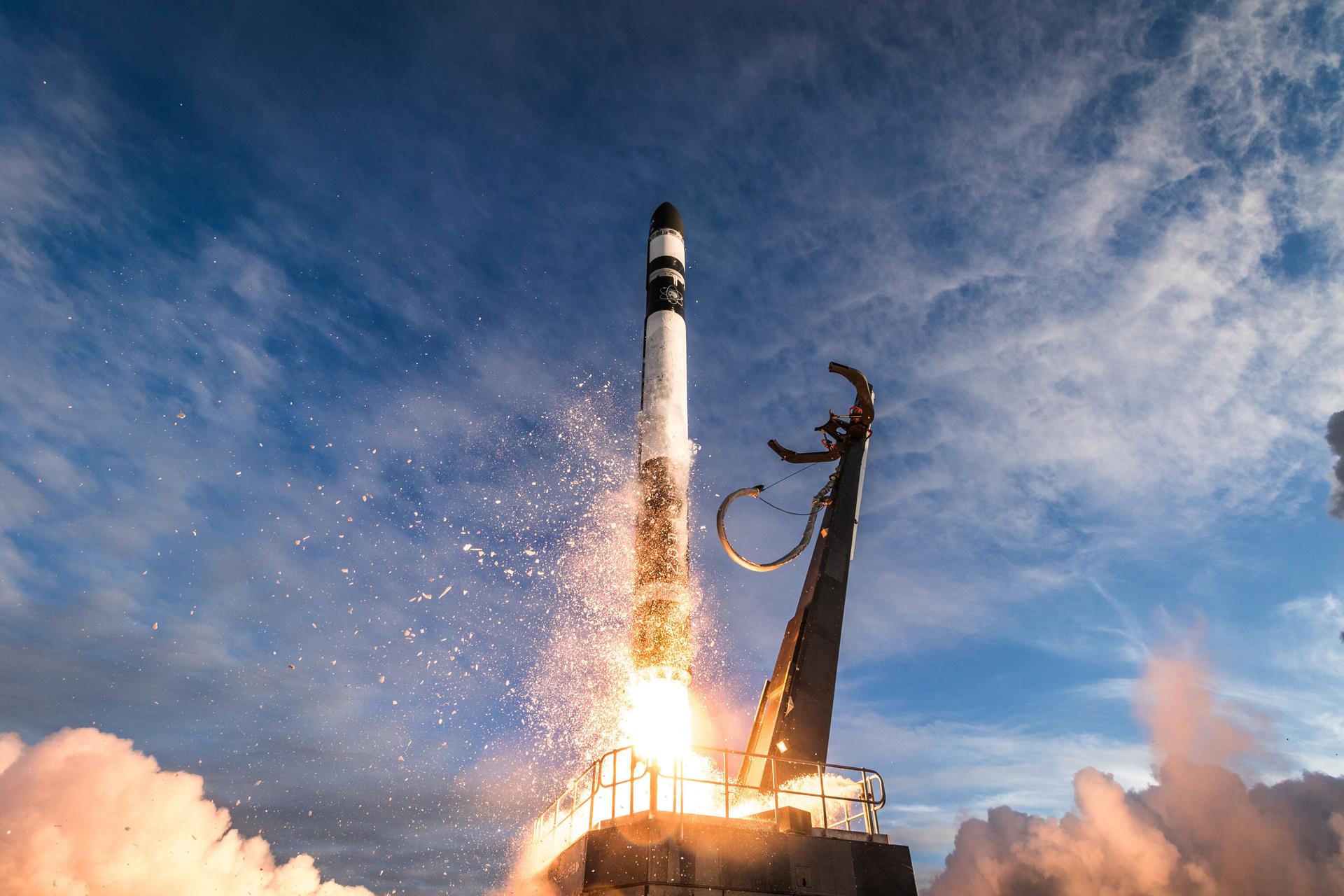
Launch Image
Electron | Daughter Of The Stars (LEO-PNT Pathfinder A)
Loading timer...
2026-03-24 NTY
TBD
To Be Determined
Current date is a placeholder or rough estimation based on unreliable or interpreted sources.

Provider Country

Rocket Lab (RL)

Rocket Lab is an American aerospace manufacturer with a wholly owned New Zealand subsidiary. The company develops lightweight, cost-effective commercial rocket launch services. The Electron Program was founded on the premise that small payloads such as CubeSats require dedicated small launch vehicles and flexibility not currently offered by traditional rocket systems. Its rocket, the Electron, is a light-weight rocket and is now operating commercially. The company is also producing a variety of spacecrafts and spacecrafts components.

Type: Commercial

Successful Launch / Total Launch: 79 / 83

Number of launch attempt this year: 5

Launchers: Electron

Spacecraft: -

Agency Country

European Space Agency (ESA)

The European Space Agency is an intergovernmental organisation of 22 member states. Established in 1975 and headquartered in Paris, France, ESA has a worldwide staff of about 2,000 employees. ESA's space flight programme includes human spaceflight (mainly through participation in the International Space Station program); the launch and operation of unmanned exploration missions to other planets and the Moon; Earth observation, science and telecommunication; designing launch vehicles; and maintaining a major spaceport, the Guiana Space Centre at Kourou, French Guiana.

Type: Multinational

Successful Launch / Total Launch : 6 / 7

Launchers: Ariane | Vega

Spacecraft: Space Rider

Wikipédia

Electron

Electron is a two-stage orbital expendable launch vehicle (with an optional third stage) developed by the American aerospace company Rocket Lab. Electron is a small-lift launch vehicle designed to launch small satellites and cubesats to sun-synchronous orbit and low earth orbit. The Electron is the first orbital class rocket to use electric-pump-fed engines, powered by the 9 Rutherford engines on the first stage. It is also used as a suborbital testbed (called HASTE) for hypersonics research.

Successful Launch / Total Launch : 79 / 83

Height: 18.0 m

Diameter: 1.2 m

Liftoff Mass: 13 t

Liftoff Thrust: 162 kN

Cost: 6000000 €

LEO / GTO capacity: 300 kg / - kg

Apogee: - km

1st flight: 2017-05-25

Daughter Of The Stars (LEO-PNT Pathfinder A)

The European Space Agency (ESA)'s LEO-PNT (Low Earth Orbit Positioning, Navigation and Timing) demonstrator mission will feature a 10-satellite constellation demonstration mission that will assess how a low Earth orbit fleet of satellites can work in combination with the Galileo and EGNOS constellations in higher orbits that provide Europe’s own global navigation system. This launch will lift 2 “Pathfinder A” satellites built by Thales Alenia Space and GMV to a 510 km altitude Low Earth Orbit.

Type: Navigation

Orbit: Polar Orbit (PO)

Window: 2026-03-24 NTY

Pad Country

Unknown Pad

Location: Rocket Lab Launch Complex 1, Mahia Peninsula, New Zealand

Launches from the pad this year / Total launches from the pad: 1 / 0

Total launches from the location: 72

Timezone: Pacific/Auckland